Village fete, building site, sports ground or shop entrance: printing banners or flags takes more than a good design, because wind, rain and the mounting surface all matter too. A solid banner on a site fence catches the wind like a sail, a beach flag without the right base tips over at the first gust, and a sign in the wrong material ages quickly on a facade. This guide helps you choose the right size, material and fixing for your outdoor advertising.
Banner, flag or sign: what suits where?
These products complement each other but do different jobs. As a rule of thumb:
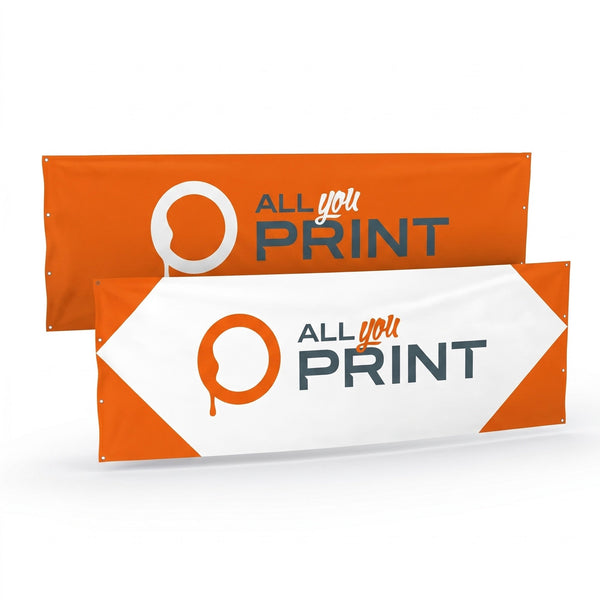
- Banners cover large surfaces on existing structures: site fences, safety barriers, scaffolding, railings or facades.
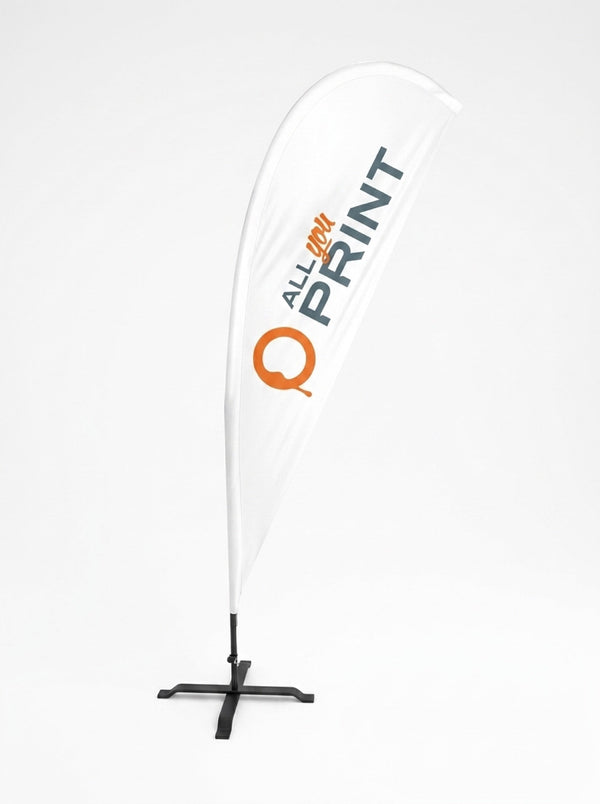
- Flags and beach flags stand freely, move in the wind and catch the eye from a distance, for example at an entrance, pitch-side or along a road.
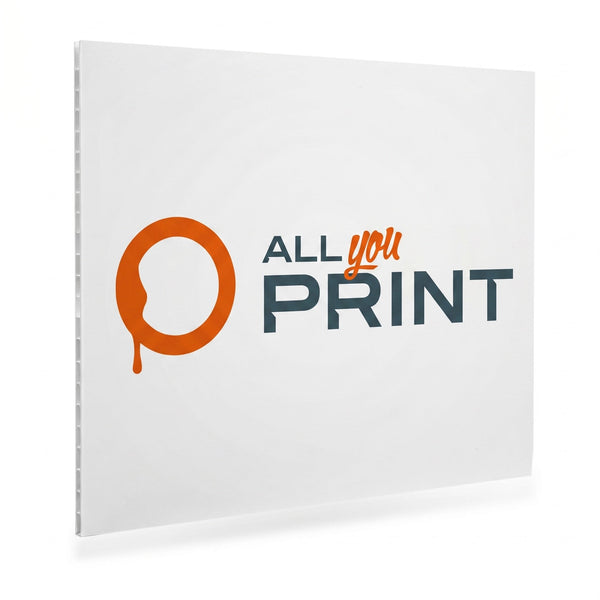
- Signs stay in the same place for a long time: a company sign, a directional sign, a practice sign or a site board.
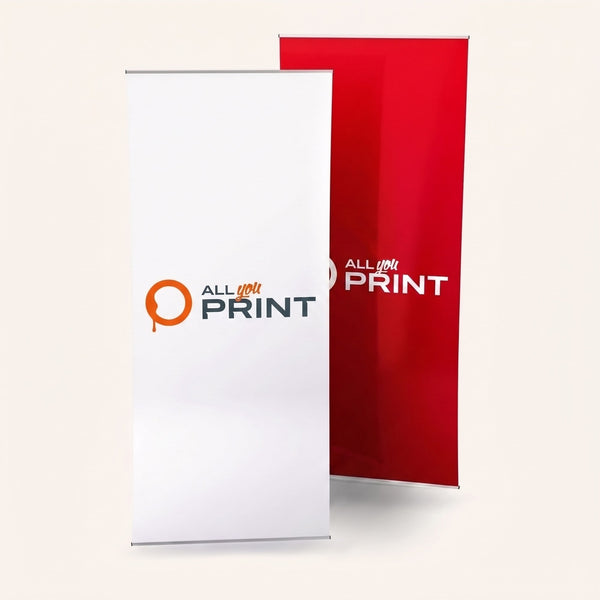
- Fabric banners are light and quick to hang, for example at a trade fair, a company event or in a showroom.
Banners: material, size and eyelets
For the material, choose between breathable mesh fabric (also available recycled), sturdy PVC banner material, budget PVC and recycled PVC. All are UV-resistant and weatherproof. Mesh lets wind pass through and is therefore the safe choice for large surfaces on fences and scaffolding. PVC is opaque and gives a solid printing surface; double-sided PVC blockout banners include a barrier layer so the print on one side doesn't show through the other.
You set the size yourself in a custom format: from 50 x 50 cm to 400 x 275 cm, and for extra-long banners from 400 x 50 cm to 999 x 300 cm, priced to the centimetre. Rectangular banners are also available in many fixed formats up to 400 x 300 cm. For common mounting structures, dimensions are already matched: banners for site fences come with 20 eyelets all round, those for safety barriers with 12, and scaffolding banners over 4 m² have a hollow hem at the top and bottom plus 6 eyelets. Hems and eyelets are chosen as finishing options in the configurator; for fixing, we recommend elastic tensioners, which you can order alongside. Several variants, such as custom-size banners from 4 m and double-sided banners, are B1-certified (fire-retardant), a plus point for events. Note: most orders allow a single design, but site-fence banners let you upload several.
Flags and beach flags: shapes, fabrics and stands
The beach flag is the classic choice for entrances, sports events and club fetes in spring and summer. The beach flag system comes in various sizes up to 90 x 422 cm, with a rotating pole in glass-fibre reinforced plastic and a swivel that lets the flag turn a full 360 degrees. For the fabric, choose 110 g polyester flag fabric, recycled flag fabric or 120 g mesh flag fabric, which offers less resistance to the wind. For a double-sided flag, the Beach Flags Basic range offers an opaque, double-layer 250 g polyester weave. Printing is done by sublimation, weatherproof and UV-resistant; the fabrics can be machine-washed at 30°C on a gentle cycle.
The base is what really determines stability. On asphalt or paving, choose a metal cross base with a tube weight or a base plate. On grass or sand, a ground spike anchors the flag deeper into soft soil. An additional five-litre tube weight, filled with water or sand, adds further ballast to the cross base.
Beyond the beach flag, other flags are available. Pole flags for masts can be ordered in a custom size, from 80 x 80 cm to 300 x 490 cm without an outrigger, or up to 150 x 490 cm with an outrigger up to 3 cm in diameter, each with loops and carabiner hooks. The kiosk flag (40 x 60 cm) is fixed to the facade with a wall bracket and comes down easily at closing time. For fans and clubs, hand-waving flags come in 70 x 50, 100 x 70 or 150 x 100 cm, with a wooden or telescopic pole.
Signs for facades, entrances and building sites
For lasting outdoor signage, aluminium composite panel is the sturdiest choice: 3 or 6 mm thick, resistant to corrosion and weather, in a custom size from 15 x 15 cm to 200 x 100 cm. Options include corner holes with stainless steel spacers, rounded corners or folded edges. The hollow-core panel (450 g, 2.5 mm) is lighter, printable on both sides and recyclable; with eyelets, corner holes or suction cups, it suits directional signs and events. As election posters, hollow-core panels are available in A2, A1, A0 or 70 x 100 cm with 6 or 10 pre-punched openings, which you fix to lamp posts, trees or fences with cable ties. The rigid foam panel (2 or 5 mm, B1-certified) suits both indoor and outdoor use, while the featherweight soft foam panel is for indoor use only.
For a practice, an office or a workshop, door and company signs in acrylic glass, aluminium composite (also brushed silver) or rigid foam come with a matching mounting system. Many signs can also be finished with a UV varnish, gloss or matt, on request.
Fixings: how to keep your outdoor advertising in place
The best-looking banner is little use if it hangs crooked after the first storm. Think about the fixing at the same time as the design:
- Elastic tensioners through the eyelets keep banners taut and give way in gusts instead of tearing.
- Cable ties fix hollow-core panels, election posters and 360-degree posters to posts and fences.
- Tube weight, base plate or ground spike secure beach flags depending on the surface.
- Stainless steel spacers mount signs elegantly with a 15 or 20 mm gap from the wall, for panels from 2 to 10 mm thick.
- Panel clamps hold panels up to 7 mm to the wall and allow a quick change of design.
One practical tip to finish: if you're advertising on public land, for example on street lamps or a pavement, check with your local council about permission first. And measure fences, barriers and masts before ordering, so the format and fixing points line up.
Frequently asked questions about outdoor advertising
Mesh or PVC: which banner suits a site fence?
For large surfaces and exposed locations, mesh fabric is the safe choice, because wind passes through it. PVC is opaque and gives a solid surface, but needs a sturdy fixing. A lighter alternative is the site-fence banner in flag fabric, with 42 eyelets all round.
How do I keep a beach flag stable in the wind?
Choose the base to suit the ground: a cross base with a tube weight or a base plate on firm ground, a ground spike on grass or sand. Mesh flag fabric further reduces wind load.
Can a banner be printed on both sides?
Yes, with double-sided PVC blockout banners: a barrier layer stops the print on one side showing through the other. They're available in many formats up to 400 x 300 cm, also in a custom size from 50 x 50 cm, with eyelets optional on the short edge or all round.
Which sign lasts longest outdoors?
For permanent signage on facades and entrances, we recommend the aluminium composite panel, thanks to its high resistance to corrosion and weather. For a single event, the lighter hollow-core panel is often enough.
You'll find every material and size in our banners, flags and beach flags and signs ranges. The price in CHF appears instantly in the configurator, the delivery time is shown before you order, and we deliver across Switzerland, whether to Zurich, Bern or Basel.
Ready to start printing?
Our in-house studio supports you from brief to finished print. Personalised quote within 24 hours.
Request a quote View all products