A business card has just a few seconds to make its case: a handshake at a trade fair, a client meeting, a networking drinks event. Too plain, and it ends up in the bin; pleasant to hold and easy to read, and it moves into a wallet or onto a desk. Here is how to design a business card people actually want to keep.
What a business card should contain
A good card answers three questions at a glance: who are you, what do you offer, and how can people reach you? Everything else is secondary. Set a clear order of priority:
- Name and role: the main element, easy to read and never smaller than the rest.
- Company and logo: placed with care, the logo ideally as a vector file.
- Contact details: phone number in international format with +41, email and website. One number is often enough.
- Address: useful for a shop, a practice or a restaurant, optional for an online-only business.
- QR code: handy if it leads to your website, a booking page or your contact details to save.
Make good use of the back. In Switzerland, it is a natural place for a second language: English on the front, German or French on the back, for a card that works across the country too. It can also carry a full-page image, your opening hours or a short strapline. On both sides, leave room to breathe: white space looks premium and draws the eye to what matters.
Choosing the right format
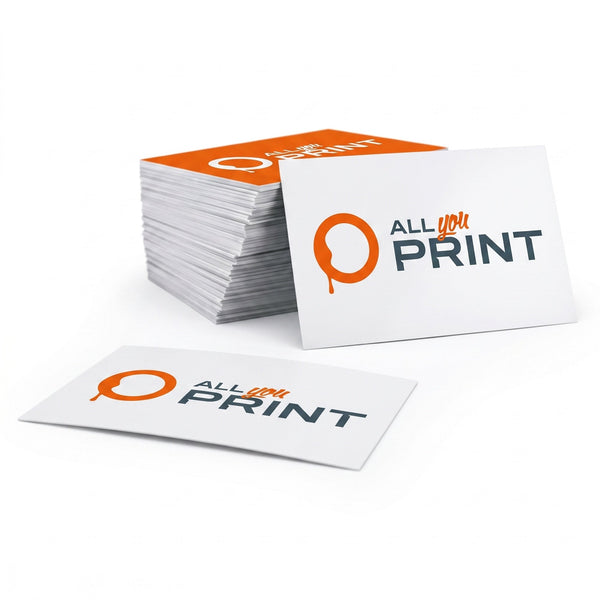
The classic format measures 8.5 x 5.5 cm and fits every card holder and wallet. For something different, custom-format business cards let you set your own width and height, from 4 x 5 cm to 21 x 29.7 cm. A square format looks modern and stands out instantly in a stack; a slightly smaller card feels understated. Keep in mind, though, that oversized cards do not fit into a card holder and tend to get put aside.
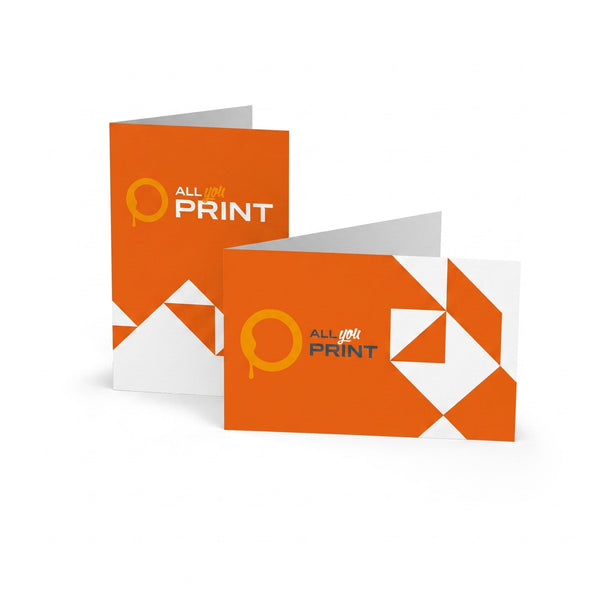
Folded business cards offer double the surface area. They suit an overview of your services, opening hours and directions, or an appointment card for a hairdresser, physiotherapist or consultant. Classic folded business cards are even available as a single piece, ideal for checking the effect in hand before ordering more.
Paper and material: touch builds trust
A business card gets touched before it gets read, so the paper matters just as much as the design. The proven standard is 300 g matt gloss paper with dispersion varnish on both sides: sturdy, pleasant to hold and professional. Chromo sulphate card is another option.
For businesses that care about sustainability, business cards come in natural or recycled paper, including grass paper, papers from certified forestry and premium recycled papers from Gmund. To make a real statement, speciality materials offer a pearl shimmer, metallic sheen or linen texture, plus cards in wood or transparent plastic. Such materials suit architecture, craft trades, jewellery or hospitality especially well, wherever material itself plays a part.
Finishes used with purpose
The right finish, used sparingly, turns a good card into one people remember. A spot varnish on the logo, embossing on the name, or a lamination that protects and elevates the card, all add a touch without overloading it. Folded business cards also offer hot foil stamping and extra colours.
A practical detail for practices, hotels and reception desks: an antimicrobial varnish can coat the card on request. And if you are ordering for a whole team, Classic business cards allow 1 to 10 designs in a single order, with the same layout and different names.
Frequently asked questions about designing business cards
What font size is easy to read on a business card?
As a rule of thumb, 7 to 8 point is easy to read for contact details, and the name can be larger. Very fine typefaces and light text on a light background lose legibility in print, so go for strong contrast instead.
How do I set up the print file for a business card?
Set up the card at final size plus 3 mm bleed on every side, so 9.1 x 6.1 cm for the standard format. Work in CMYK, with images at 300 dpi and fonts embedded, then export a PDF with one page per side.
Which paper looks the most premium?
It depends on your brand. 300 g matt gloss paper with dispersion varnish looks clean and professional; grass paper, Gmund papers or speciality materials with a pearl or metallic effect bring more character. If you are unsure, start small: most business cards are available from 10 pieces.
How many business cards should I order?
Base it on how often you meet people: someone who regularly meets clients or works a trade fair stand needs more than someone who only hands the card out occasionally. You see the price for each quantity in CHF instantly in the configurator, so you can compare print runs straight away.
Order your business card
Once the content, format and paper are settled, put your card together in the configurator: the price in CHF appears instantly, and we deliver across Switzerland. Find every option, from the classic to the folded card in a speciality material, under business cards. To match, notepads and pens with your logo round out your business stationery.
Ready to start printing?
Our in-house studio supports you from brief to finished print. Personalised quote within 24 hours.
Request a quote View all products